
Custom software
Custom web applications and internal tools
If a spreadsheet is currently holding your business process together, and one person is the only one who understands it, that spreadsheet is a liability with a deadline on it.
The tools that pay for themselves
The best custom tool is usually small and unglamorous. A quoting calculator that ends the back-and-forth on pricing. A client portal so customers stop emailing to ask where their job stands. A dashboard that pulls three systems into one screen so nobody re-keys anything at month end.
The maths is simple enough to do on a napkin. If a tool saves five hours a week and those hours cost $40, it pays for a $9,997 build in about a year and then keeps paying. If it does not clear that bar, we will tell you it is not worth building. Not everything should be software.
Calculators are the underrated one
A calculator on a public page does two jobs at once, which is unusual. It qualifies the visitor, because someone who runs the numbers is a serious buyer and someone who does not was never going to call. And it earns links and rankings, because a useful tool is one of the few things people share without being asked.
We built a College Navigator for Lucramed and property valuation capture for Keyport Alaska. Both do the same thing structurally: give the visitor something genuinely useful, and get a qualified lead as a byproduct rather than as a toll.
Integration is where the time goes
Building the interface is rarely the hard part. Connecting to what you already run is. Your CRM, your accounting system, your scheduling tool, and the one piece of industry software with an API written in 2011 and documented nowhere.
We scope that first and honestly. If a system has no API and no export, that constraint shapes the whole project and you should hear it in week one, not month three. Sometimes the answer is that the integration is not feasible and the tool should work standalone. That is a fine outcome as long as nobody discovered it late.
How custom work gets scoped
Fixed-price software with a vague scope goes badly for everyone. We narrow it before quoting.
Map the process
What happens now, who touches it, where the time goes. Usually the process gets simplified here and the software gets smaller, which is good for you.
Check the integrations
Every system it has to talk to, tested for whether it actually can. This happens before the quote, not after.
Build the smallest version
The one workflow that hurts most, working end to end, in front of real users early. Features get added once something is in use rather than guessed at up front.
Extend
Add the next workflow once the first is earning. Long build cycles with no one using anything is how custom software becomes shelfware.
Where we have done this

Lucramed
A custom College Navigator tool sitting inside a financial coaching brand, doing the qualifying before the first conversation.
View project
Keyport Alaska
Property search and valuation capture, which turns a browsing investor into a named lead.
View project
Attu AI
Custom interactions built to make an AI firm feel as sharp as the product it sells.
View project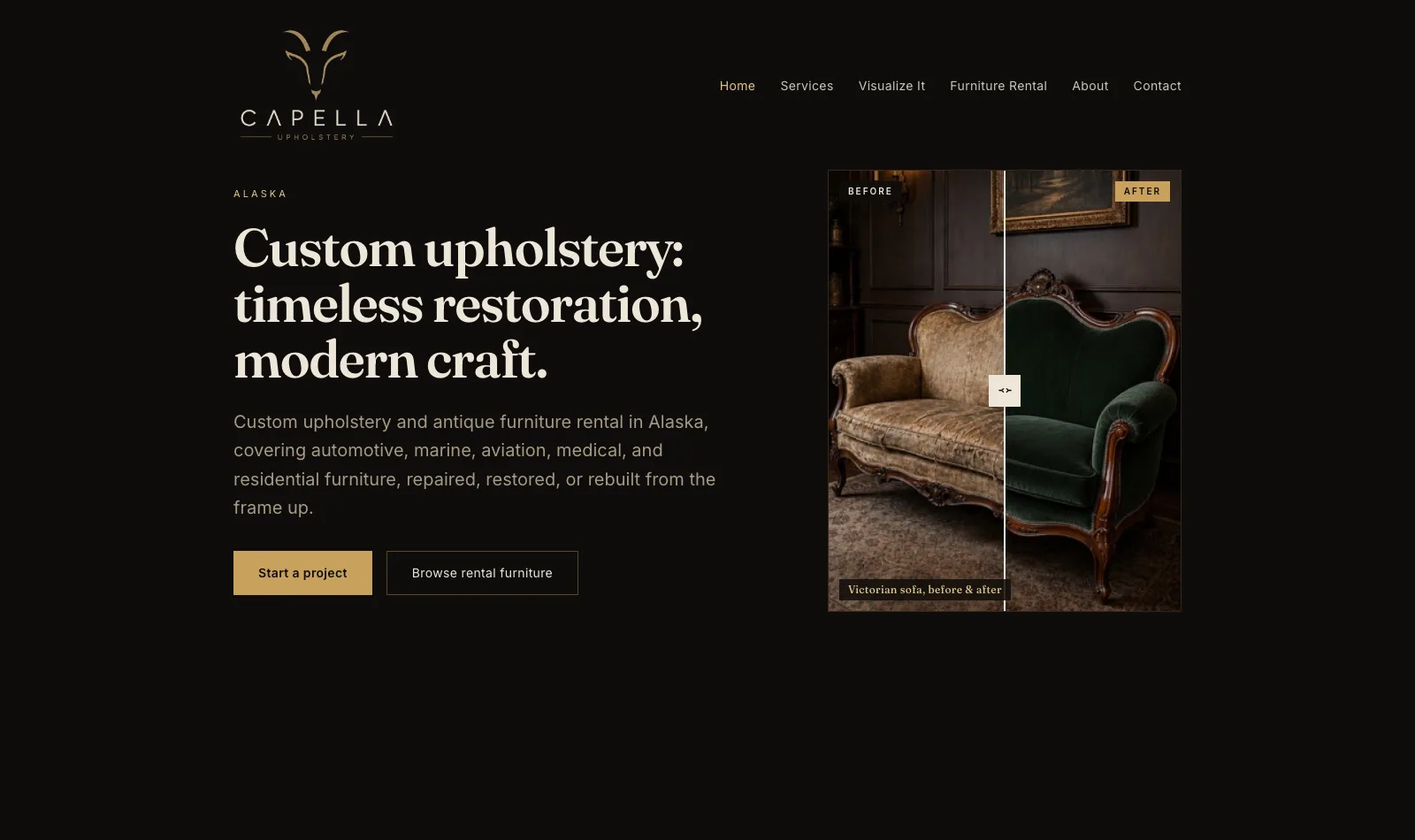
Capella Upholstery
A fabric preview tool that renders a chosen material onto the customer’s own photo, so an upholstery decision can be made before anything is ordered.
View projectCommon questions
Web applications, answered
How much does a custom web application cost?
Most fall in the Harbor or Flagship range on our pricing page, so $9,997 upward, and genuinely complex work is quoted per project. The variable is almost never the interface. It is how many systems it has to talk to.
How do I know if a custom tool is worth it?
Count the hours it saves per week and multiply by what those hours cost. If it does not pay for itself inside about eighteen months, it probably should not be built, and we will say so rather than take the project.
Can you integrate with software we already use?
Usually. If it has an API or can export on a schedule, yes. We check this before quoting rather than after, because an integration that turns out to be impossible in month three is the most expensive kind of surprise.
Who owns the code?
You do, on full payment, same as a website. We keep ownership of pre-existing frameworks and internal tooling we bring to the project, but the application built for your business belongs to your business.
What if we need changes after launch?
Custom applications usually run on a support arrangement, because software that people depend on daily needs someone responsible for it. That is quoted separately from the build and it is not compulsory.